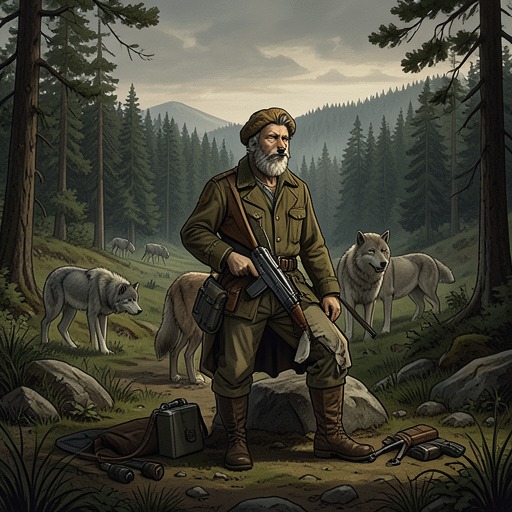
Natural Regulation of Wolf Population Size
Never Cry WolfNatural Regulation of Wolf Population Size in the book is a system of interacting limits, not a single mechanism: wolf families occupy finite hunting territories, many adults do not breed, litter size varies with food, and disease can sharply reduce populations when ecological balance fails. Through Farley Mowat’s observations and the knowledge shared by Ootek, the account replaces the image of unchecked wolf abundance with one of a population shaped by space, prey, family life, and periodic hardship.
Population Estimates and Territorial Spacing
A semi-official estimate put the wolf population of the Keewatin region at 30,000. On paper, that amounted to about one wolf for every six square miles. Since much of the area was water or barren rock, however, the effective density appeared closer to one wolf per two square miles. The figure implied a crowded landscape, but Mowat and Ootek encountered no such uniform concentration.
Instead, the wolves were scattered in family groups, each generally occupying a territory of 100 to 300 square miles. The distribution could vary sharply from place to place. Two families had denned within half a mile of one another at one site; Ootek also reported finding three females with litters denning within a few feet of each other on an esker near the Kazan River. By contrast, Mowat and Ootek traveled for three days through apparently suitable country along the Thlewiaza River without finding wolf tracks, scat, or hair.
Those contrasting observations led Mowat to lower the estimate to 3,000 wolves, a figure he still considered potentially too high. The contrast matters to the account’s explanation of population control: wolves were not spread evenly across the land, and a regional total could conceal both close local groupings and extensive areas with no sign of them. Available territory, rather than a simple count of animals, was central to understanding how many families the country could support.
Breeding, Age, and Family Life
Ootek explained that female wolves did not breed until they were two years old and males until they were three. Adolescents generally remained with their parents before reaching breeding age. Even then, maturity did not guarantee that a wolf could establish a family: suitable hunting territory was limited, and not every adult could secure a place where a litter could be raised.
The resulting restraint was ecological as well as social. If more wolves occupied the country than its prey could support, the prey population would fall and the wolves themselves would face hunger. Some adults might therefore remain without mates for years while waiting for a territory to become available. The account also emphasizes that the period of intense mating appetite lasts only about three weeks each year, a short season within a longer life shaped by limited space and food.
Nonbreeding adults were not necessarily isolated from family life. Ootek described the wolf family as a communal group in which adults helped rear pups; some, he believed, might prefer the role of an aunt or uncle, sharing in the care of young without becoming parents. One example he recounted was a male he had encountered over sixteen years. The wolf fathered a litter in each of the first six years Ootek knew him. After his mate disappeared during the seventh winter, possibly poisoned by bounty hunters farther south, he returned to the den the following spring. Another pair’s pups were raised there, while the older male remained part of the group and helped provide for them.
Food Supply and Reproduction
The number of pups in a litter also varied with conditions. When prey was abundant, or wolf numbers were relatively low, females could have litters as large as eight. When food was scarce or wolves were numerous, litters might contain only one or two pups. The account compares this pattern with that of rough-legged hawks, which might lay five or six eggs when small mammals were plentiful, but only one or none when mice and lemmings were scarce. In both examples, reproduction responds to the food base rather than proceeding at a fixed rate regardless of conditions.
Mowat’s observations at Wolf House Bay helped establish why food availability could not be judged solely by the presence of Caribou. Rodents were abundant in the mossy bogs, and he eventually concluded that the wolves raising families beyond the summer caribou range lived largely, perhaps almost entirely, on mice. Ootek added that wolves also ate many ground squirrels and sometimes seemed to prefer them to Caribou. He reported that wolves caught fish as well, including Northern pike. In Mowat’s later analysis of wolf scat, about 48 percent of samples contained rodent remains; other identifiable items included Caribou bones and hair and bird feathers. These varied food sources show a flexible diet, but they do not remove the limits imposed when prey becomes scarce across the region.
Disease and Ecological Imbalance
Disease is presented as an additional check on wolf numbers, particularly when other limits fail. If the balance is upset, often through human interference, wolves may become too numerous for their prey. As food dwindles, physical weakness can progress from malnutrition to starvation; epidemics of rabies, distemper, or mange can then reduce the population to a small surviving remnant. Disease in this account is not a routine, isolated explanation for wolf numbers, but a severe consequence of scarcity and disrupted balance.
The events of 1946 illustrate how several pressures could coincide. Lemmings, whose population peaks every four years, were then at a low point in their cycle. At the same time, depleted Caribou herds changed their migration and largely bypassed southern central Keewatin. The resulting food shortage affected local people, foxes, and wolves. Rabies, latent among the starving foxes, spread to wolves as well. This episode makes the relationship between prey cycles and predator survival explicit: when two important food sources were simultaneously limited, the wolves’ capacity to persist was sharply reduced.
Seasonal Movement and Regulation
The account also distinguishes the family territories of the breeding season from winter organization. In winter, wolves followed Caribou south from the tundra into the taiga. A family might travel together, while two or three small groups could temporarily join into a larger band and later separate again. There were no fixed rules for these mergers, but hunting imposed a practical limit: wolves needed to cooperate to bring down prey, while a group that was too large might not obtain enough food from a kill. Bands of five to ten animals appeared to offer a workable balance between cooperation and competition.
Winter bands had no fixed territories, and when unfamiliar bands met, they could greet one another and continue separately. Such concentrations were uncommon. The means by which the animals remained dispersed was not known, although Chippewayan accounts attributed a role to urine messages left on prominent rocks, trees, and points along trails and lakes. The account presents the explanation cautiously: the mechanism was uncertain, but the observed pattern was that nomadic wolves generally avoided crowding together unless starvation overtook the land.
Together, territorial spacing, delayed or absent breeding, food-linked litter sizes, adaptable feeding, seasonal group size, and disease form a connected picture of population regulation. The wolves are neither infinitely numerous nor held in balance by one simple rule. Their numbers depend on whether families can find territory and prey, whether young can be raised, and whether changing migrations or human interference unsettle those conditions. Ootek’s knowledge and Mowat’s field observations thus recast wolf abundance as a contingent ecological process, tied closely to the fortunes of the animals on which wolves depend.